What Is Multimodal AI, and Why Does It Matter?
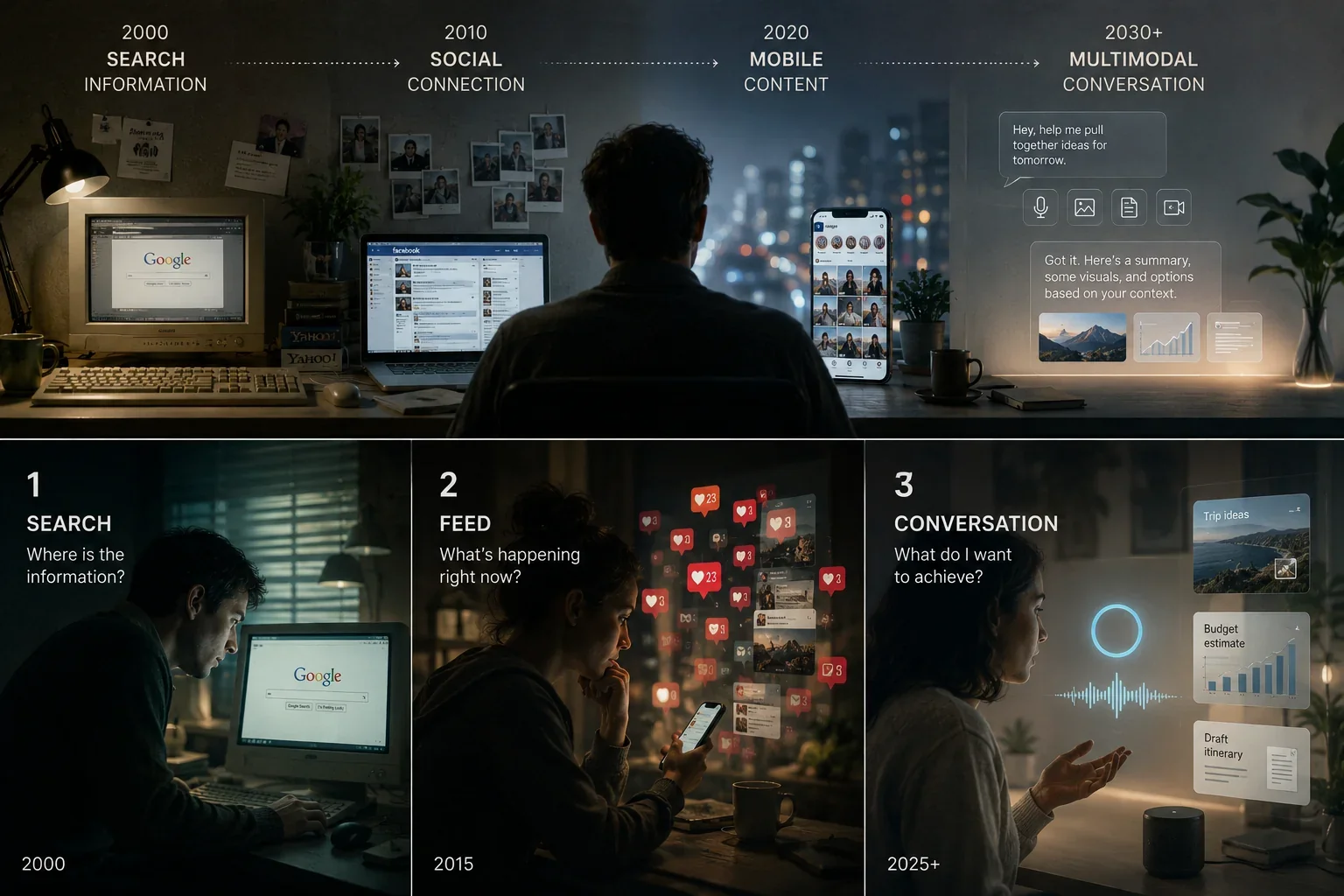
It has been around 25 years since I did my first Google search.
At the time, search felt like magic.
You no longer needed to know where information lived. You could just ask, and the web would open.
That changed how we related to knowledge.
Then social media changed how we related to attention, identity and content.
Suddenly every business, creator, school, event and community needed graphics, posts, stories, slides and updates.
An entire generation of tools grew around that moment.
But multimodal AI points to something different again.
Multimodal AI means AI that can work across different types of information: text, images, voice, audio, video, documents and visual inputs.
It is not just that AI can read an image, listen to audio, understand video or respond to documents.
It is that the way we interact with technology is changing.
Instead of only typing, searching, scrolling and clicking, we can increasingly speak, show, upload, record, sketch and ask in more natural ways.
That has big implications for creative tools, business software, social platforms and how organisations communicate.
The feed era rewarded endless content production.
But the next shift may not be about making more content.
It may be about moving away from rigid interfaces, endless feeds and constant publishing, toward technology that works more naturally with how humans communicate, decide and operate.
For appliers, that means AI will not just sit in a chat box. It will increasingly sit across the way we write, design, plan, meet, brief, teach, sell and share information.
For builders, it means the next layer of value may not be another dashboard or content tool. It may be the systems underneath: workflows, context, permissions, handoffs, memory and trust.
And this is the part we think matters most.
To be ready for multimodal AI, businesses need to get their information organised.
Not perfectly. Not in some giant transformation project.
But clearly enough that AI can understand what things are, where they belong, what they relate to, and what it is allowed to do with them.
That means better data organisation.
Clearer files. Cleaner workflows. Useful context. Shared language. Less knowledge trapped in people’s heads. Systems that are easier for humans and AI to work with.
Because multimodal AI does not remove the need for structure.
It makes structure more important.
This is the kind of shift both Appliers and Builders need to understand now, because it changes not only what AI can produce, but how people and systems interact.
We’ll be exploring this next Wednesday, 27 May in Byron with Teri Yu from OpenAI, alongside a local conversation about what this means for work, business, creativity and the systems we are building next.
If you’re in Byron, come along: https://theremix.au/events/from-openai-to-byron-may-26